Most things don’t last. Not even most colours. When you go to an art exhibit and you see the white marble statues, just remember that they were once brightly coloured monuments of their time.
The colours on the statues were painted bright reds, oranges, greens, and blues centuries ago. If you wanted to see what the colours were you would need to use a light that could detect different wavelengths from the different metals used on the statues. The practice is called Polychrome – the act of painting architecture, pottery, and sculptures in multiple colours. This was a practice done worldwide in multiple eras from the Age of Antiquity to Modern Times.
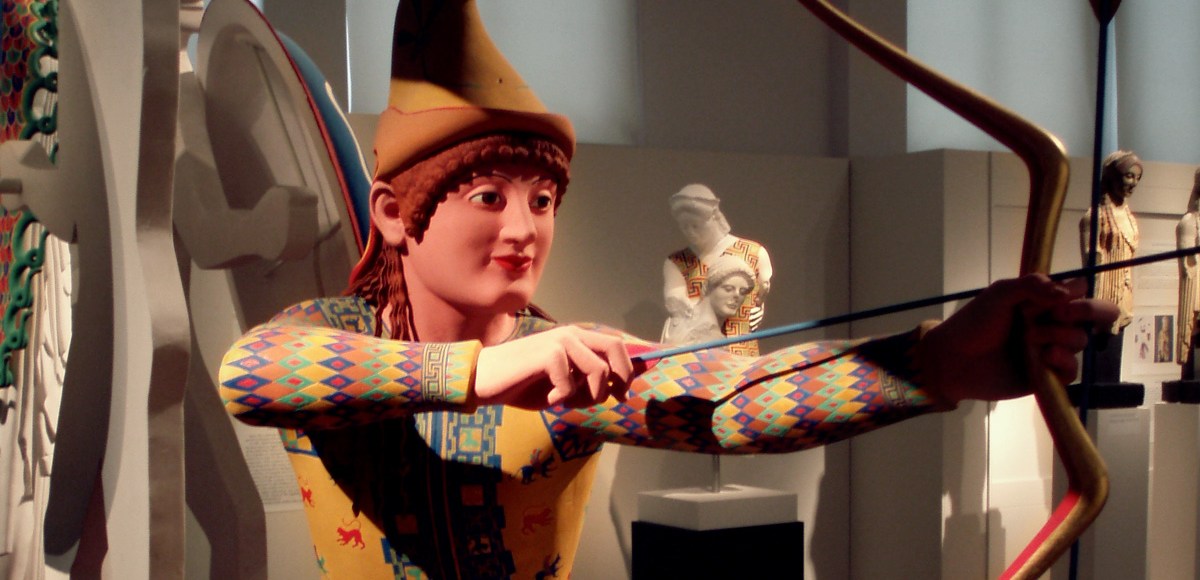
Reconstructed colour scheme on a Trojan archer from the Temple of Aphaia, Aegina (Source: Wikipedia: Public Domain)
These colours faded because of multiple reasons. Weathering, sunlight, fire, water and poor maintenance. Most of the paints used in the past used products that were not only dangerous but were the raw pigment colours from natural products that were not treated for outdoor use and had reactive compounds. But most of the colours that are on ancient statues, buildings and ornamental have had poor maintenance and were left outside for centuries making the colours fade.
The sculptures we recognize were being created they were vibrantly painted sculptures that are almost unrecognizable when compared to the sculptures we see today. However, these sculptures might have faded long before the beginning of the Neoclassical era. When artists like Michelangelo and Raphael went through the resurgence of Roman art the sculptures they might have seen were completely white. The attention to detail and dramatic scenes that the early sculptors used during the Roman age were why the Neoclassical sculptors had an influence. But they liked the pristine white finish the sculptures looking like they were unpainted white marble.
Peplos Kore sculpture with reconstructed polychrome. On the left: The original c. 530 BC, fine-grained Parian marble in the Acropolis Museum in Athens, Greece. On the right: Peplos Kore’s colour reconstruction painted as Artemis on display in the Gods in Colour exhibition.
In the early books about art history stated that the sculptures were always white. A book by Johann Joachim Winckelmann called The History of Ancient and Art History wrote about the Apollo of Belvedere of 120 AD being beautiful because it was white marble. Johan Joachim Winckelmann was a German art historian and archaeologist whose written work had an influence on the Neoclassical movement in the late 18th century. There was evidence of sculptures and other works of art with colour.
They were painted with materials containing radioactive properties which is how we know what the colours look like by shining ultraviolet lights to detect the metal properties. It’s a similar technique used to detect forgeries. Most fake paintings use different materials that may not use the same radioactive pigments that were readily available for use back then.
Reconstructionists would paint replicas printed from a 3D scan to reveal what the original work looked like. There have been some recreations from Photoshop manipulation to show what the statues could look like.
Banner Credit: Under The Moonlight with Photoshop – Reconstructed colour scheme on a Trojan archer from the Temple of Aphaia, Aegina (Source: Wikipedia – Public Domain)


 Under The Moonlight
Most things don’t last. Not even most colours. When you go to an art exhibit and you see the white marble statues, just remember that they were once brightly coloured monuments of their time.
The colours on the statues were painted bright reds, oranges, greens, and blues centuries ago. If you wanted to see what the colours were you would need to use a light that could detect different wavelengths from the different metals used on the statues. The practice is called Polychrome – the act of painting architecture, pottery, and sculptures in multiple colours. This was a practice done worldwide in multiple eras from the Age of Antiquity to Modern Times.
(Source: Wikipedia: Public Domain)
These colours faded because of multiple reasons. Weathering, sunlight, fire, water and poor maintenance. Most of the paints used in the past used products that were not only dangerous but were the raw pigment colours from natural products that were not treated for outdoor use and had reactive compounds. But most of the colours that are on ancient statues, buildings and ornamental have had poor maintenance and were left outside for centuries making the colours fade.
The sculptures we recognize were being created they were vibrantly painted sculptures that are almost unrecognizable when compared to the sculptures we see today. However, these sculptures might have faded long before the beginning of the Neoclassical era. When artists like Michelangelo and Raphael went through the resurgence of Roman art the sculptures they might have seen were completely white. The attention to detail and dramatic scenes that the early sculptors used during the Roman age were why the Neoclassical sculptors had an influence. But they liked the pristine white finish the sculptures looking like they were unpainted white marble.
In the early books about art history stated that the sculptures were always white. A book by Johann Joachim Winckelmann called The History of Ancient and Art History wrote about the Apollo of Belvedere of 120 AD being beautiful because it was white marble. Johan Joachim Winckelmann was a German art historian and archaeologist whose written work had an influence on the Neoclassical movement in the late 18th century. There was evidence of sculptures and other works of art with colour.
They were painted with materials containing radioactive properties which is how we know what the colours look like by shining ultraviolet lights to detect the metal properties. It’s a similar technique used to detect forgeries. Most fake paintings use different materials that may not use the same radioactive pigments that were readily available for use back then.
Reconstructionists would paint replicas printed from a 3D scan to reveal what the original work looked like. There have been some recreations from Photoshop manipulation to show what the statues could look like.
Banner Credit: Under The Moonlight with Photoshop – Reconstructed colour scheme on a Trojan archer from the Temple of Aphaia, Aegina (Source: Wikipedia – Public Domain)
Reference:
Vox (video and article) – The white lie we’ve been told about Roman statues
The MET – Chroma: Ancient Sculpture in Color
The New Yorker – The Myth of Whiteness in Classical Sculpture
The Ancient Home – Were Greek & Roman Statues Painted ?
The True Colors of the Classical World
Share this: