The military has used different types of camouflage over the years for instance netting even pink at some point. Naval ships have been repainted multiple times with one goal – to disguise themselves from the enemy ships. It’s hard to hide a large ship throughout all seasons, weather conditions and lighting that happen out at sea. Plus, the paint helped with heat distribution during warm climates, maintained a sense of cleanliness by hiding dirt and wear, and standardized ships of similar usage among other countries. Most of these changes happened during wartime and were out of innovation of trying something new.
Before the warship evolution, most steamships were painted in any colour. Most battleships were covered in coal dust and had little to no advantage not being seen over the horizon by the enemy. Some common ship colours were black for the hulls, white for the superstructures, red for the ship below the waterline and yellow for the masts and funnels. Wartime events like the Russo-Japanese War, rival imperial powers who wanted control over the Korean empire and China through large military operations in the Liaodong Peninsula and Mukden in China, and the Yellow Sea and the Sea of Japan, had naval warships change their colours to improve camouflaging techniques.
Battleship Grey
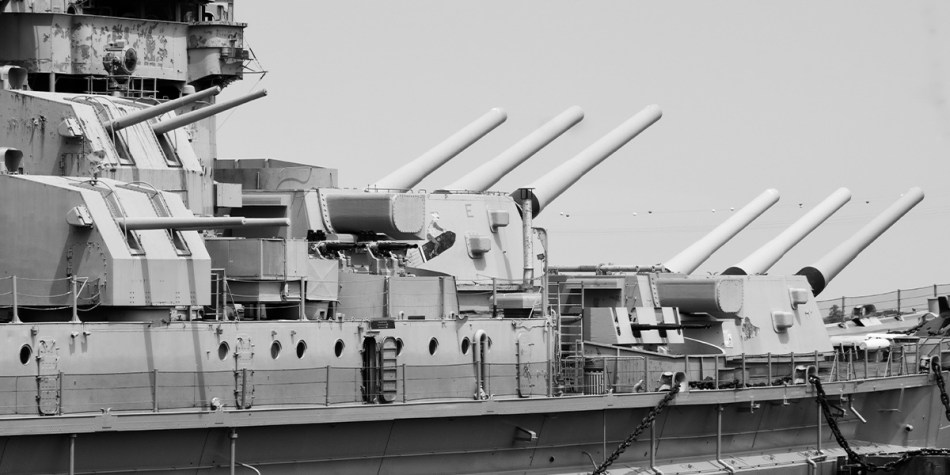
Before painting a battleship grey happened, most battleships were painted white to keep the ship visible during peace times due to no radar technology system invented until 1904 and to keep the sailors busy cleaning the ship. Battleship grey is used universally (in most countries) on all warships for practicality and camouflage. It is fair to say that most battleships are painted with some sort of variation of grey as a part of their naval ship design. Battleship grey is a term which means it’s a range of greys that were used on warships around WWI, even though the United States Navy started using more neutral greys for their ships during the Spanish-American war. Some common variations of grey were Haze Grey which had reflective pigments to reduce infrared signatures and reduce external ship temperatures up to 20 degrees Celsius, and Storm Grey which had polysiloxane (a polymer with silicon-oxygen and organic groupings) that improved durability and fire resistance.
It reduces the contrast of the ship with the horizon and vertical patterns in the ship’s appearance. The grey blended in with haze, fog and cloudy conditions made the grey hard to see near the horizon line. Light grey near the horizon was hard to see.
The Royal Navy‘s revolutionary HMS Dreadnought, launched in 1906, gave its name to the type. By Adam Cuerden – U.S. Naval Historical Center, Source: Wikipedia. Public Domain.
The grey was originally used as a rust deterrent due to most battleships being made of out iron and steel. The paint was a micaceous hematite which deters rust because hematite is an iron oxide material that doesn’t react to atmospheric oxygen like iron which rusts. The colour was associated with old silver. It wasn’t known as Battleship Grey until 1905.
The manufacturing of the ships and aircrafts was a lucrative business by 1944 that had to be painted a matching grey colour. The paint product had a shelf-life of two years. It was used for military readiness, not for aesthetic reasons; furthermore, the paint was expensive to use because it would be replaced with more rust-resistant paint. The paint added to the overall surplus during the world wars due to the usage and new wartime technologies being invented. The two types of warcrafts that weren’t grey were submarines and hospital ships.
Mountbatten Pink
Mountbatten pink is a greyish mauve also known as Plymouth pink. It was a pink shade used on naval ships during the Second World War as camouflage.
WWII British Royal Navy Admiral Lord Mountbatten was escorting a convoy in the HMS Kelly in 1940. The Royal Navy suffered many tremendous losses in the first year of the Second World War to U-boats and Luftwaffe and a vital supply route to the island country. The ships were vulnerable to attack at dawn and dusk because the ships were large grey objects against a pink sky.
He noticed the Union-Castle liner fully with civilians disappeared into the gloaming due to the distinctive lavender mauve grey hull colour. He was convinced that the Union-Castleliner had a great cover and disappeared during the dawn and dusk. He created the colour by mixing medium grey with a small amount of Venetian red to match the rosy hue and blend the ship into the pink sky. Most ships and destroyers in his flotilla were painted Mountbatten pink by the command of Lord Mountbatten.
Mountbatten Pink HEX code #997A8D
It was later refined to a lighter tone for all ships within the next two years in pink. Even though it was never tested formally it did perform well but stood out in the mid-day when the sky wasn’t pink. Another effect that would counteract its effectiveness would be the Purkinje effect which implies that as nighttime approaches longer wavelengths of light will appear darker whereas shorter wavelengths will appear brighter. This means reds will become darker in decreasing light more than blues and greens.
Other Captains followed Lord Mountbatten’s lead to paint their flotillas pink but due to the official camouflage section from the Admiralty, they opted for more practical design patterns, for instance, bold lines in blues and greys. Most ships retained their pink colour until 1942 when the paint had people convinced of its effectiveness. For instance, the USS Winslow was painted from battleship grey to Mountbatten Pink then back to battleship grey before its retirement in 1950. The battle HMS Kenya nicknamed the “Pink Lady” fought in battle fire off the Vågsøy (Vaagso) Island near the Norwegian coast yet only had cosmetic damage and no casualties after the fight.
Great White Fleet
The battleships in the early 20th century were called the Great White Fleet because the hulls were painted white, the bow had a red, white, and blue banner and the superstructure was painted buff. The battleships were a collection of five U.S. Connecticut Class War Ships. It was dispatched under US President Theodore Roosevelt as a worldwide voyage between December 1907 to February 1909 was a multifaceted purpose of a showcase of American goodwill, pomp, and ceremony of nationalism in the rise of prewar militarism around the world. The ships showcased mobility, speed and power. The popularity of the capital boats withered after the big gun battleship evolution and the construction of the Royal Navy HMS Dreadnought in 1906. The last “Great White” fleet ship to sail was the USS New Hampshire.
Postcard of a newspaper article about the Great White Fleet from America entering Port Jackson, N.S.W. – 20 August 1908 – Source: Flickr, Aussie~mobs. Public Domain.
Razzle Dazzle
This was a design pattern rather than a flat colour that went on the ships. This was to make range-finding devices that relied on seeing it like a telescope harder to use against the ships because of how it broke up the appearance of the horizon from three miles away.
The design is a form of disruptive camouflage based on confusion instead of concealing. The goal was to deceive the eye about the size, outline, course of the ship and speed. It was developed as a response to the threats of German U-boat submarines causing a lot of significant losses for Britain during World War II. Large irregular black-and-white zebra-like patterns, zigzags and angular shapes were painted on the sides and upper works of a ship to create distorted effects. In certain places, the painted on effect can reduce shadows and disguise the bow wave.
It was invented by Norman Wilkinson, a British artist who first had the idea to paint the naval fleet with bright weird lines and shapes. But John Graham Kerr, a Unionist British parliamentarian, had a greater influence on the camouflage painting technique. He wrote to Winston Churchill on September 24th, 1914 advocating for disruptive coloration and countershading referencing American artist Abbott Handerson Thayer who also advocated a protective coloration during the Spanish-American war on American ships in 1898 with friend George de Forest Brush. Kerr wanted to destroy continuous lines while making it harder to hit with long-range gunfire. The British called it Dazzle Camouflage while the Americans called it Razzle Dazzle.
USS West Mahomet in dazzle camouflage, 1918. By Unknown author. Source: Wikipedia. Public Domain.
The technique wasn’t exclusive to the Americans and British. For example, Japanese Lieutenant Commander Shizuo Fukui experimented with the pattern during World War II but substituted white with light grey because white is the colour of death in Japan. It was made obsolete after the invention of radar devices and the boats were painted the standard grey again.
Blegvad, Kaye. “Pink As Camouflage.” The Pink Book: An Illustrated Celebration of the Color, from Bubblegum to Battleships, Chronicle Book, San Francisco, California, 2019, p. 102.
St. Clair, Kassia. “Mountbatten Pink.” The Secret Lives of Colour, John Murray, London, England, 2016, p. 120-121.


 Under The Moonlight
The military has used different types of camouflage over the years for instance netting even pink at some point. Naval ships have been repainted multiple times with one goal – to disguise themselves from the enemy ships. It’s hard to hide a large ship throughout all seasons, weather conditions and lighting that happen out at sea. Plus, the paint helped with heat distribution during warm climates, maintained a sense of cleanliness by hiding dirt and wear, and standardized ships of similar usage among other countries. Most of these changes happened during wartime and were out of innovation of trying something new.
Before the warship evolution, most steamships were painted in any colour. Most battleships were covered in coal dust and had little to no advantage not being seen over the horizon by the enemy. Some common ship colours were black for the hulls, white for the superstructures, red for the ship below the waterline and yellow for the masts and funnels. Wartime events like the Russo-Japanese War, rival imperial powers who wanted control over the Korean empire and China through large military operations in the Liaodong Peninsula and Mukden in China, and the Yellow Sea and the Sea of Japan, had naval warships change their colours to improve camouflaging techniques.
Battleship Grey
Before painting a battleship grey happened, most battleships were painted white to keep the ship visible during peace times due to no radar technology system invented until 1904 and to keep the sailors busy cleaning the ship. Battleship grey is used universally (in most countries) on all warships for practicality and camouflage. It is fair to say that most battleships are painted with some sort of variation of grey as a part of their naval ship design. Battleship grey is a term which means it’s a range of greys that were used on warships around WWI, even though the United States Navy started using more neutral greys for their ships during the Spanish-American war. Some common variations of grey were Haze Grey which had reflective pigments to reduce infrared signatures and reduce external ship temperatures up to 20 degrees Celsius, and Storm Grey which had polysiloxane (a polymer with silicon-oxygen and organic groupings) that improved durability and fire resistance.
HEX code #848482
It reduces the contrast of the ship with the horizon and vertical patterns in the ship’s appearance. The grey blended in with haze, fog and cloudy conditions made the grey hard to see near the horizon line. Light grey near the horizon was hard to see.
The grey was originally used as a rust deterrent due to most battleships being made of out iron and steel. The paint was a micaceous hematite which deters rust because hematite is an iron oxide material that doesn’t react to atmospheric oxygen like iron which rusts. The colour was associated with old silver. It wasn’t known as Battleship Grey until 1905.
The manufacturing of the ships and aircrafts was a lucrative business by 1944 that had to be painted a matching grey colour. The paint product had a shelf-life of two years. It was used for military readiness, not for aesthetic reasons; furthermore, the paint was expensive to use because it would be replaced with more rust-resistant paint. The paint added to the overall surplus during the world wars due to the usage and new wartime technologies being invented. The two types of warcrafts that weren’t grey were submarines and hospital ships.
Mountbatten Pink
Mountbatten pink is a greyish mauve also known as Plymouth pink. It was a pink shade used on naval ships during the Second World War as camouflage.
WWII British Royal Navy Admiral Lord Mountbatten was escorting a convoy in the HMS Kelly in 1940. The Royal Navy suffered many tremendous losses in the first year of the Second World War to U-boats and Luftwaffe and a vital supply route to the island country. The ships were vulnerable to attack at dawn and dusk because the ships were large grey objects against a pink sky.
He noticed the Union-Castle liner fully with civilians disappeared into the gloaming due to the distinctive lavender mauve grey hull colour. He was convinced that the Union-Castle liner had a great cover and disappeared during the dawn and dusk. He created the colour by mixing medium grey with a small amount of Venetian red to match the rosy hue and blend the ship into the pink sky. Most ships and destroyers in his flotilla were painted Mountbatten pink by the command of Lord Mountbatten.
HEX code #997A8D
It was later refined to a lighter tone for all ships within the next two years in pink. Even though it was never tested formally it did perform well but stood out in the mid-day when the sky wasn’t pink. Another effect that would counteract its effectiveness would be the Purkinje effect which implies that as nighttime approaches longer wavelengths of light will appear darker whereas shorter wavelengths will appear brighter. This means reds will become darker in decreasing light more than blues and greens.
Other Captains followed Lord Mountbatten’s lead to paint their flotillas pink but due to the official camouflage section from the Admiralty, they opted for more practical design patterns, for instance, bold lines in blues and greys. Most ships retained their pink colour until 1942 when the paint had people convinced of its effectiveness. For instance, the USS Winslow was painted from battleship grey to Mountbatten Pink then back to battleship grey before its retirement in 1950. The battle HMS Kenya nicknamed the “Pink Lady” fought in battle fire off the Vågsøy (Vaagso) Island near the Norwegian coast yet only had cosmetic damage and no casualties after the fight.
Great White Fleet
The battleships in the early 20th century were called the Great White Fleet because the hulls were painted white, the bow had a red, white, and blue banner and the superstructure was painted buff. The battleships were a collection of five U.S. Connecticut Class War Ships. It was dispatched under US President Theodore Roosevelt as a worldwide voyage between December 1907 to February 1909 was a multifaceted purpose of a showcase of American goodwill, pomp, and ceremony of nationalism in the rise of prewar militarism around the world. The ships showcased mobility, speed and power. The popularity of the capital boats withered after the big gun battleship evolution and the construction of the Royal Navy HMS Dreadnought in 1906. The last “Great White” fleet ship to sail was the USS New Hampshire.
Razzle Dazzle
This was a design pattern rather than a flat colour that went on the ships. This was to make range-finding devices that relied on seeing it like a telescope harder to use against the ships because of how it broke up the appearance of the horizon from three miles away.
The design is a form of disruptive camouflage based on confusion instead of concealing. The goal was to deceive the eye about the size, outline, course of the ship and speed. It was developed as a response to the threats of German U-boat submarines causing a lot of significant losses for Britain during World War II. Large irregular black-and-white zebra-like patterns, zigzags and angular shapes were painted on the sides and upper works of a ship to create distorted effects. In certain places, the painted on effect can reduce shadows and disguise the bow wave.
It was invented by Norman Wilkinson, a British artist who first had the idea to paint the naval fleet with bright weird lines and shapes. But John Graham Kerr, a Unionist British parliamentarian, had a greater influence on the camouflage painting technique. He wrote to Winston Churchill on September 24th, 1914 advocating for disruptive coloration and countershading referencing American artist Abbott Handerson Thayer who also advocated a protective coloration during the Spanish-American war on American ships in 1898 with friend George de Forest Brush. Kerr wanted to destroy continuous lines while making it harder to hit with long-range gunfire. The British called it Dazzle Camouflage while the Americans called it Razzle Dazzle.
The technique wasn’t exclusive to the Americans and British. For example, Japanese Lieutenant Commander Shizuo Fukui experimented with the pattern during World War II but substituted white with light grey because white is the colour of death in Japan. It was made obsolete after the invention of radar devices and the boats were painted the standard grey again.
Banner credit: Photo by John Kostyk on Unsplash
Reference:
Naval Historical Society of Australia – Shades of Grey
Science Direct – The Purkinje rod-cone shift as a function of luminance and retinal eccentricity
Colour Studies – Dec 15 Mountbatten Pink
Smithsonian Magazine – When the British Wanted to Camouflage Their Warships, They Made Them Dazzle
Does It Rust – Does Hematite Rust?
Warfare History Network – The Rise and Fall of Dazzle Camouflage
History.com – The WWI ‘Dazzle’ Camouflage Strategy Was So Ridiculous It Was Genius
Blegvad, Kaye. “Pink As Camouflage.” The Pink Book: An Illustrated Celebration of the Color, from Bubblegum to Battleships, Chronicle Book, San Francisco, California, 2019, p. 102.
St. Clair, Kassia. “Mountbatten Pink.” The Secret Lives of Colour, John Murray, London, England, 2016, p. 120-121.
McCormick, Margaret. The Nothing That Consumes: How Battleship Gray Changed Design, Saturated Space, London, England, 2013, p. 2-4.
Share this: