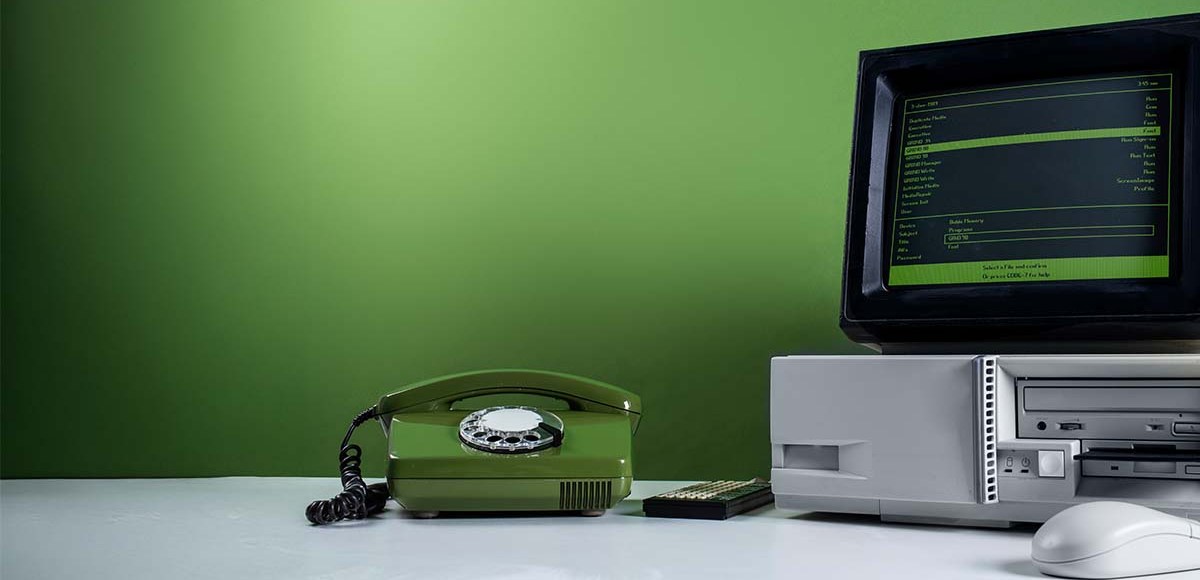
If you were a child of the 80s or 90s you remember seeing these colours at your local library when you had to look up a book or order a book from the database. The bright green and black monitors were everywhere. Why would you see this green on your screens? And what is this green?
These computers had monochrome monitors, therefore, they used one light source for the monitor. It can vary with green, white, or amber for its monitors. The green was used mostly for readability because the characters were sharp and clear. While the white and black screens glowed too brightly. The amber screens were common for readability, but the green screens were more popular. It only had text-based commands for its systems, and images were very limited to a grainy image made of halftones. These screens had an afterglow effect from the last image presented on the screen due to the phosphors on the screen continuing to emit light, but now dimming because the monitor is turned off. It’s called persistence time, based on the duration of time the glow stops. The majority of these monitors were used since the 1960s and were phased out for a full-colour modern monitor by the 1980s. A common name for these monitors was “green screen” because of the glowing green “P1” phosphor screen.
The monitors had vacuum tubes containing one or more electron guns. These guns emit electron beams to manipulate images on a phosphorescent screen. This was called a cathode-ray tube (CRT). It was popular with television sets, monitors and old radar devices. They work by the tube in a heavy, long yet fragile glass envelope, enclosed to prevent the emitted electrons from colliding with air molecules and scattering before they hit the tube’s face. The interior of the tube is evacuated to less than a millionth of atmospheric pressure. CRTs carry risks of violent implosion when handled incorrectly. It could project glass at rapid speeds. The face of the CRT is typically made of either thick lead glass or shatter-resistant barium-strontium glass created to block most X-ray emissions. CRTs are the reason why devices like monitors and television sets have their weight. A short history of CRT devices was invented in 1897 by Karl Ferdinand Braun until it was phased out for LCD devices for display in the early 2000s. In the 1980s, IBM created the Color Graphics Adapter (CGA) in 1981, which was the first graphics card for an IBM PC, the Enhanced Graphics Adapter (EGA) in 1984, which was succeeded by the Video Graphics Adapter (VGA) in 1987, which was a video display controller.
A phosphor screen is a phosphorescent which is a type of photoluminescence. It works by light emission from any form of matter after the absorption of photons (electromagnetic radiation). The screen lights up with cathodoluminescent substances, which glow when struck by an electron beam in a cathode-ray tube.


 Under The Moonlight
If you were a child of the 80s or 90s you remember seeing these colours at your local library when you had to look up a book or order a book from the database. The bright green and black monitors were everywhere. Why would you see this green on your screens? And what is this green?
These computers had monochrome monitors, therefore, they used one light source for the monitor. It can vary with green, white, or amber for its monitors. The green was used mostly for readability because the characters were sharp and clear. While the white and black screens glowed too brightly. The amber screens were common for readability, but the green screens were more popular. It only had text-based commands for its systems, and images were very limited to a grainy image made of halftones. These screens had an afterglow effect from the last image presented on the screen due to the phosphors on the screen continuing to emit light, but now dimming because the monitor is turned off. It’s called persistence time, based on the duration of time the glow stops. The majority of these monitors were used since the 1960s and were phased out for a full-colour modern monitor by the 1980s. A common name for these monitors was “green screen” because of the glowing green “P1” phosphor screen.
The monitors had vacuum tubes containing one or more electron guns. These guns emit electron beams to manipulate images on a phosphorescent screen. This was called a cathode-ray tube (CRT). It was popular with television sets, monitors and old radar devices. They work by the tube in a heavy, long yet fragile glass envelope, enclosed to prevent the emitted electrons from colliding with air molecules and scattering before they hit the tube’s face. The interior of the tube is evacuated to less than a millionth of atmospheric pressure. CRTs carry risks of violent implosion when handled incorrectly. It could project glass at rapid speeds. The face of the CRT is typically made of either thick lead glass or shatter-resistant barium-strontium glass created to block most X-ray emissions. CRTs are the reason why devices like monitors and television sets have their weight. A short history of CRT devices was invented in 1897 by Karl Ferdinand Braun until it was phased out for LCD devices for display in the early 2000s. In the 1980s, IBM created the Color Graphics Adapter (CGA) in 1981, which was the first graphics card for an IBM PC, the Enhanced Graphics Adapter (EGA) in 1984, which was succeeded by the Video Graphics Adapter (VGA) in 1987, which was a video display controller.
A phosphor screen is a phosphorescent which is a type of photoluminescence. It works by light emission from any form of matter after the absorption of photons (electromagnetic radiation). The screen lights up with cathodoluminescent substances, which glow when struck by an electron beam in a cathode-ray tube.
Banner Credit: A view of a retro computer by Freepik
Share this: