This is a revision of a previous post about Monet’s Shadow Study from 2019.
This took place a few years before the first synthetic colour was invented and marketed to the public. Some painters experiment with new materials and a new focus of inspiration. Monet did that with his Haystack painting series. He was studying how light can hit the same object at different times throughout the year. It’s easier to think about with modern technology like a camera but this was the birth of a new movement that studied light and mood more than any other era.
The violettomania is the response to the popularity of the colour. It was a written article by Oskar Reutersward in the 1950s explaining the usage of synthetic blues by the Impressionists. Violettomania is the name of the fad of excessive blues, violets and pinks in their paintings. The critics said they were suffering from seeing blue. It was everywhere and must have been overwhelming. The book was called Violetomania by the Impressionists written in the 19th century about the blue colour fad.
Monet used cobalt violet in most of his paintings for his waterlilies and irises paintings. During this time, Monet was in his mid career phase and used preferred paints for his series that wasn’t limited to cobalt violet like cobalt blue, viridian green and cadmium yellows.
The study of the sunsets, sunrises, weather or type of field would be reflected in his paintings. The haystacks were a pair of haystacks of possibly barely or oats for one year under the conditions of multiple kinds of seasonal weather. The haystacks belonged to his neighbour’s farm, Monsieur Quéruel. Monet noticed the light changing on the haystacks and asked Quéruel’s stepdaughter, Blanche Hoschedé, to use the field to paint the haystacks.
His daily routine involved waking in the middle of the night, carting paints and canvasses across the field to paint the haystacks with his assistant. He would have two sets of canvasses to work out of and only develop the one that closely resembled the fluctuation of light. He would complete a set of paintings by 10 am.
I am struggling with a series of different effects [haystacks]… but at this season, the sun sets so fast I can not follow it.
Claude Monet on Painting the Haystacks
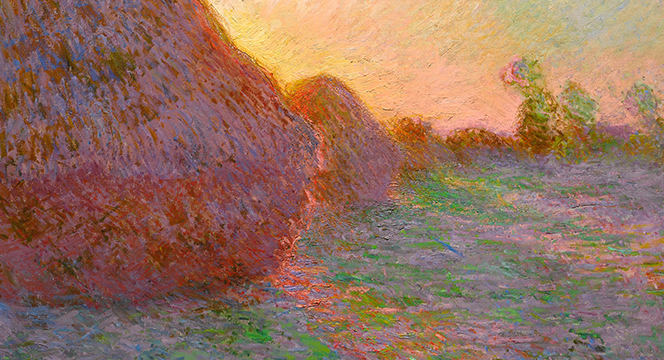
The winter editions of The Haystacks have the lights and shadows captured in violets and orange hues with brown hints underneath the snow.
The popularity of the colour gave painters new insight that shadows are coloured of complementary hues when light strikes them not black. Since the sun is yellow the shadows must be purple. He used other colours like lead white, cadmium yellow, vermilion, and French ultramarine to create depth and shadow variations. Monet wanted to study one subject’s interaction with light and shadows which he did for several years. He completed 30 paintings in 3 years as he investigated the interaction with light under different times of day and weather conditions.
The Haystacks series was a great success. Many called the series “Faces of Landscapes” as they represented the countryside but the subject of the paintings were the sheaves of wheat or barley being stored. It funded him enough money to buy a house in Giverny, France where he constructed a waterlily pond. The Haystacks, Water Lilies and Rouen Cathedral would have been painted around the same time shuffling from each series while the paint would dry.
What suddenly became clear to me was the unsuspected power of the palette, which I had not understood before and which surpassed my wildest dreams.
Wassily Kandinsky reflecting on Claude Monet Haystack in his memoirs
Banner credit: Cropped painting by Claude Monet, Haystacks, 1890
Resources:
Watch Me Paint – Violettomania
NATIONAL GALLERY TECHNICAL BULLETIN – VOLUME 28, 2007
Haystacks, Claude Monet – Claude Monet Paintings, Biography, and Quotes
The National Gallery – Monet’s Palette in the Twentieth Century: ‘Water-Lilies’ and ‘Irises’
My Modern Met – Exploring How Monet’s Famous ‘Haystacks’ Paintings Explored the Beauty of the Changing Seasons


 Under The Moonlight
This is a revision of a previous post about Monet’s Shadow Study from 2019.
This took place a few years before the first synthetic colour was invented and marketed to the public. Some painters experiment with new materials and a new focus of inspiration. Monet did that with his Haystack painting series. He was studying how light can hit the same object at different times throughout the year. It’s easier to think about with modern technology like a camera but this was the birth of a new movement that studied light and mood more than any other era.
The violettomania is the response to the popularity of the colour. It was a written article by Oskar Reutersward in the 1950s explaining the usage of synthetic blues by the Impressionists. Violettomania is the name of the fad of excessive blues, violets and pinks in their paintings. The critics said they were suffering from seeing blue. It was everywhere and must have been overwhelming. The book was called Violetomania by the Impressionists written in the 19th century about the blue colour fad.
Monet used cobalt violet in most of his paintings for his waterlilies and irises paintings. During this time, Monet was in his mid career phase and used preferred paints for his series that wasn’t limited to cobalt violet like cobalt blue, viridian green and cadmium yellows.
The study of the sunsets, sunrises, weather or type of field would be reflected in his paintings. The haystacks were a pair of haystacks of possibly barely or oats for one year under the conditions of multiple kinds of seasonal weather. The haystacks belonged to his neighbour’s farm, Monsieur Quéruel. Monet noticed the light changing on the haystacks and asked Quéruel’s stepdaughter, Blanche Hoschedé, to use the field to paint the haystacks.
His daily routine involved waking in the middle of the night, carting paints and canvasses across the field to paint the haystacks with his assistant. He would have two sets of canvasses to work out of and only develop the one that closely resembled the fluctuation of light. He would complete a set of paintings by 10 am.
The winter editions of The Haystacks have the lights and shadows captured in violets and orange hues with brown hints underneath the snow.
The popularity of the colour gave painters new insight that shadows are coloured of complementary hues when light strikes them not black. Since the sun is yellow the shadows must be purple. He used other colours like lead white, cadmium yellow, vermilion, and French ultramarine to create depth and shadow variations. Monet wanted to study one subject’s interaction with light and shadows which he did for several years. He completed 30 paintings in 3 years as he investigated the interaction with light under different times of day and weather conditions.
The Haystacks series was a great success. Many called the series “Faces of Landscapes” as they represented the countryside but the subject of the paintings were the sheaves of wheat or barley being stored. It funded him enough money to buy a house in Giverny, France where he constructed a waterlily pond. The Haystacks, Water Lilies and Rouen Cathedral would have been painted around the same time shuffling from each series while the paint would dry.
Banner credit: Cropped painting by Claude Monet, Haystacks, 1890
Resources:
Watch Me Paint – Violettomania
NATIONAL GALLERY TECHNICAL BULLETIN – VOLUME 28, 2007
Haystacks, Claude Monet – Claude Monet Paintings, Biography, and Quotes
The National Gallery – Monet’s Palette in the Twentieth Century: ‘Water-Lilies’ and ‘Irises’
My Modern Met – Exploring How Monet’s Famous ‘Haystacks’ Paintings Explored the Beauty of the Changing Seasons
Share this: