

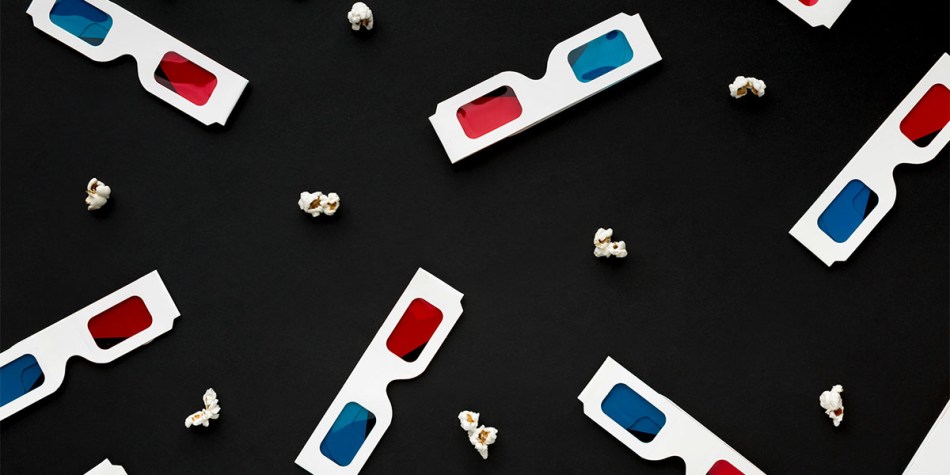
The pop-out graphics that our mind makes are easier to create and a part of film history. From the red and blue glasses for drive-in classics to the black glasses for modern IMAX movies, 3D glasses were always there in the cinemas.
The history of 3D glasses dates back to the early 20th century when various techniques were developed to create the illusion of three-dimensional depth in movies, images, and other forms of visual media. Here’s a brief overview of the evolution of 3D glasses:
The first 3D glasses: Charles Wheatstone and Sir David Brewster invented stereoscopes that enables depth perception. Wheatstone created a stereoscope to explain the concept of stereoscope to a general audience in 1832. His device had two images one of each side with a mirror viewer reflecting back the image through the viewer. Brewster enhanced the invention by creating the first lenticular stereoscope by supplementing the lenticular design and lightbox optical design by 1849. It resembled binoculars for viewers to see 3D images from photography. The at-home model of the stereoscope machine was introduced by Oliver Wendell Holmes through magazine advertisements in The Atlantic Monthly. They had a range of subjects, mostly of landscapes, monuments and composed narrative scenes of a humorous or slightly suggestive nature.
Anaglyph Glasses (19th Century): The earliest form of 3D glasses, known as anaglyph glasses, were developed in the late 19th century Joseph D’Almeida based on basic stereoscope and stereographic images by looking through different light filters it achieves a 3D image. The name “anaglyph” comes from the Greek names for again+sculpture. Early forms of anaglyphic films were created for movies that have two endings imposed on top of each other. If a viewer wants a happy ending, they would view the film through the red filter. If a viewer wants a sad ending, they would view the film through the green filter. The technique was called “plasticgrams” by William Friese-Greene. The 1922 film, The Power of Love, was one of the first films that utilized this effect. Danger Mouse used transparent acetate glasses they called space googles for the manipulated images. Anaglyph images are created by superimposing three still images, each taken from a slightly different perspective, and using colour filters to separate the images. The colour filtered images unaligned from the key image so that when the viewer sees the image with the glasses it’s 3D. Typically red and cyan is used for this technique but green and red, and blue and red are commonly used, too. Viewers wear glasses with corresponding colour filters to perceive the images in 3D.
Polarized Glasses (1930s): In the 1930s, polarized 3D glasses were introduced as an alternative to anaglyph glasses. Polarized glasses use differently polarized lenses to filter light waves and separate the images intended for the left and right eyes. This creates the illusion of depth perception when viewing polarized 3D content.
Shutter Glasses (1950s and beyond): Shutter glasses, also known as active shutter glasses, were developed in the 1950s. These glasses work by rapidly alternating the visibility of the left and right lenses in synchronization with the display device. This technique creates the perception of 3D depth by presenting different images to each eye. During the 3D movie boom in the 1950s polarized glasses overtook anaglyphic glasses. Films like “House of Wax” (1953) created an immersive experience in theatres which was a part of the gimmicky theatre experience at that time. The modern electronic 3D glasses that are considered standard in modern media viewing. They are battery powered glasses that uses alternating moving shutters for both eyes to create a full resolution image in synced with the on-screen refresh rate. The image can look dimmer with flickering images.
RealD Glasses (2005 and beyond): RealD is a popular 3D cinema technology introduced in 2005 by the RealD inc. company. RealD glasses use circular polarization to separate the left and right eye images projected onto the screen. The glasses contain passive polarizing filters that ensure each eye receives the correct image for 3D viewing. Movies like Avatar (2009) and Gravity (2012) had immersive effects especially in exclusive IMAX releases. They are the standard in theatre 3D glasses used today.
Passive Polarized Glasses (Current Standard): Many modern 3D systems, including those used in cinemas and home entertainment, utilize passive glasses that rely on polarization or other optical techniques to separate the left and right eye images. Passive glasses are lightweight, inexpensive, and more comfortable to wear compared to active shutter glasses.
Throughout history, 3D glasses have been used to enhance the immersive experience of watching movies, playing video games, viewing photographs, and engaging with other forms of visual media.
Advancements in technology continue to refine the effectiveness and accessibility of 3D glasses, making 3D viewing more realistic and enjoyable for audiences worldwide.
Banner Credit:
Arrangement of 3d glasses on black background – Not AI created – Image by freepik
References:
https://www.math.brown.edu/tbanchof/Yale/project14/3dhistory.html
https://awolvision.com/blogs/awol-vision-blog/history-of-3d-glasses#!
https://www.britannica.com/technology/photography/Development-of-stereoscopic-photography
https://www.wattsgallery.org.uk/explore-victorian-virtual-reality/a-short-history-of-stereoscopy
https://www.lifewire.com/3d-passive-polarized-vs-active-shutter-1847836
 Under The Moonlight
0 comments on “How 3D Glasses Work”